For Christmas I got season 1 of the TV show Once Upon a Time. The first thing I watched was the bonus features, because I love seeing how these things are made. What stuck out to me was how many times the writers of the show said "we wondered what would happen if" or "this path was obvious, so we asked ourselves what if..."
The biggest thing to me is when they were talking about Prince Charming's back story. They knew everyone would expect to know his story--the royal prince with a rich father who would take Snow White away. So they asked "What if that wasn't his story? What if he was actually a pauper?" From this simple realization that the story would be more interesting with Charming having a different back story, the show has a whole other plot to go into with the conflicts of becoming a prince without having been raised as one.
As I've been plotting my next book, I've asked myself these same questions. What would the audience expect to happen from this? If it's something good--like the heroine winning, then I don't touch it. But who's expected to be the bad guy? The good guy? What cliches are in this genre that I want to avoid? Then from this, asking "what if this happened?" Sometimes it's awful. But sometimes it's good. And I've found that things are a lot less predictable and a lot more interesting.
Do you have any tricks for plotting your story?

Showing posts with label writing tips. Show all posts
Showing posts with label writing tips. Show all posts
Thursday, January 3, 2013


Tuesday, December 18, 2012
Sites that help a writer
The internet can be a distraction, sure, but I've also found a lot of websites that help my writing in some way. Here are some of those:
- Pinterest. I delayed getting one of these, because I thought it was so cliche to get one, and if I did, people would think I was using it for wedding ideas. But it's been really helpful in gathering visual ideas for my story. They let you have 3 secret boards, so no one else can see it, if you want to keep things private (like me).
- Etsy. A lot of people post their crafts on this site. There's jewelry, clothes, costumes, and other bobbles. I found a necklace there that matches what I imagine an important necklace in my book to be.
- Wordle. Copy and paste your entire book (or just a section) and see what words keep cropping up so you know what to avoid.
- Babynamesworld.com. I can't get over suggesting this site for finding names. They have the best advanced search option I've ever seen.
Tuesday, June 12, 2012
Begone, repeating words!
This is going to be a short post, but I think it'll be very helpful.
When I was at the LDStorymaker's Conference, someone told me about Wordle. You can copy and paste an entire novel at wordle.net. It then makes a cloud of your most-used words. Obviously, your character's names will probably be the biggest, but then looking at the rest of the cloud, you can find your tick words. I had "back" as the biggest word after the names of my main characters, and also "like" was surprisingly big.
This is a really helpful tool in finding those repeating words that we automatically gravitate to.
When I was at the LDStorymaker's Conference, someone told me about Wordle. You can copy and paste an entire novel at wordle.net. It then makes a cloud of your most-used words. Obviously, your character's names will probably be the biggest, but then looking at the rest of the cloud, you can find your tick words. I had "back" as the biggest word after the names of my main characters, and also "like" was surprisingly big.
This is a really helpful tool in finding those repeating words that we automatically gravitate to.
Tuesday, May 8, 2012
My crazy goals and how I'll finish them
ICYMI: I'm writing a book for my honors thesis (just got the e-mail that my proposal was approved. Whew!). What this means? DEADLINES. My book will have to be shiny and perfect and ready to defend by next January. Maybe to some this isn't a big deal, but for me...yeah, this is going to push me.
As part of the proposal I had to set deadlines for myself. Deadline for my first draft? A month from now. That's about 2,000 words a day, six days of the week. I started up yesterday.
So now, I'm getting serious. Last week in a late-night youtube marathon, I came across this video from Charlie McDonnell (charlieissocoollike) where he talks about how he keeps up his goals. I learned from him, who learned from the internet, who learned from Jerry Seinfeld, about don't break the chain.
 Have a calendar, and every time you meet your daily goal (of exercise or for people like us, writing) cross off the day. Keep crossing off days and don't break the chain. It seems to be working for Charlie, and I mean, if Jerry Seinfeld endorses it, who am I to argue?
Here's hopes of 2,000 words a day, six days a week for the next month.
Do you have any goals? What are you doing to meet them?
As part of the proposal I had to set deadlines for myself. Deadline for my first draft? A month from now. That's about 2,000 words a day, six days of the week. I started up yesterday.
So now, I'm getting serious. Last week in a late-night youtube marathon, I came across this video from Charlie McDonnell (charlieissocoollike) where he talks about how he keeps up his goals. I learned from him, who learned from the internet, who learned from Jerry Seinfeld, about don't break the chain.

Here's hopes of 2,000 words a day, six days a week for the next month.
Do you have any goals? What are you doing to meet them?
Thursday, October 27, 2011
An Easy Tip
This is something that I learned in my class on writing literary criticism:
To see the pattern of your sentences and how long they are, wherever there's a period make a dot on the margin. This way, you can visualize the length of your sentences and see what areas are either lacking in dots or abounding in them. And, this doesn't take up a lot of your time (it's the whole fixing it that takes longer).
This helped me a lot in writing my essay, because it's important to have a lot of different sentence lengths when writing an essay. And in general, I think writing creatively a variety of sentence lengths is good, unless one is making a point with the length of syntax.
Just something quick I thought I'd share. :)
To see the pattern of your sentences and how long they are, wherever there's a period make a dot on the margin. This way, you can visualize the length of your sentences and see what areas are either lacking in dots or abounding in them. And, this doesn't take up a lot of your time (it's the whole fixing it that takes longer).
This helped me a lot in writing my essay, because it's important to have a lot of different sentence lengths when writing an essay. And in general, I think writing creatively a variety of sentence lengths is good, unless one is making a point with the length of syntax.
Just something quick I thought I'd share. :)
Thursday, April 21, 2011
Setting Collage
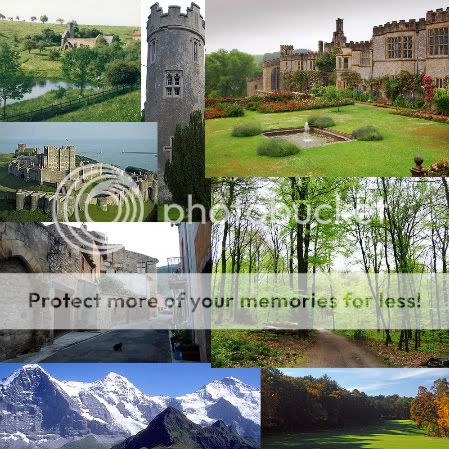
As I'm working on developing a story that's been in my head for about the past month, I realized that I really needed to get setting down. It's the entire background of the story, I needed it to be right. And, as this story is a fantasy set in a made-up medieval land, there are a lot of different ways that the reader could picture it: Disney-fied, dark and gritty, maybe some Lord of the Rings; medieval fantasy has so many different possible connotations that I wanted to make sure mine was clear.
But how would I do this? Well, I had to know what I wanted, for one. And then I had to make sure that I would stick to it. The character collages I did earlier really inspired me. As I don't have magazines on medieval castles and landscapes, I instead browsed around the internet and made up a quick collage with the different parts of setting that will be important to my story. This is what I made:
 This is the collage for the exterior at least. I'll probably do one on the interior as well. I'm hoping this will help me as I write to establish the setting by having a visual to refer back to when I need to describe something.
But how would I do this? Well, I had to know what I wanted, for one. And then I had to make sure that I would stick to it. The character collages I did earlier really inspired me. As I don't have magazines on medieval castles and landscapes, I instead browsed around the internet and made up a quick collage with the different parts of setting that will be important to my story. This is what I made:
Monday, April 11, 2011
That's so cliche!
Well, that title was certainly cliche.
As I've learned more about the art of writing, something that has always worried me is that I will use the dreaded cliches and my work will be unoriginal and dull.
But, now I've found a tool that I would like to share with you all. The cliche finder!
Just put in your text, and it'll highlight cliches. Although, you should definitely still look your work over again, because I think some phrases become used too much and are more of trends than outlasting cliches, and then there's always cliche situations that will occur in writing as well. But it's a nice place to start.
As I've learned more about the art of writing, something that has always worried me is that I will use the dreaded cliches and my work will be unoriginal and dull.
But, now I've found a tool that I would like to share with you all. The cliche finder!
Just put in your text, and it'll highlight cliches. Although, you should definitely still look your work over again, because I think some phrases become used too much and are more of trends than outlasting cliches, and then there's always cliche situations that will occur in writing as well. But it's a nice place to start.
Saturday, March 5, 2011
Why adverbs are bad
In the comments of the last post, WoollyBird asked why adverbs shouldn't be used in writing.
I think this is best shown in example. I've taken the liberty to take a paragraph from one of my favorite books, The Hunger Games by Suzanne Collins, and rewrite it with adverbs.
I suppose instead of treating adverbs like the plague, the better rule is to use them as little as possible. Here, Suzanne Collins does use two adverbs--"completely mad" and "twitch hysterically." But what adverbs do is slow down the reading. If strong verbs can be used instead, the writing comes quicker and the sight of what's going on is clearer to the reader. For example, which was better, "swiftly run away" or "bolt"? The strong verb "bolt" uses one word instead of three to describe the action of Peeta and the Careers, and does so with more power and action.
I think this is best shown in example. I've taken the liberty to take a paragraph from one of my favorite books, The Hunger Games by Suzanne Collins, and rewrite it with adverbs.
It's mayhem. The Careers have suddenly woken to a full-scale tracker jacker attack. Peeta and a few others have the sense to quickly drop everything and swiftly run away. I can hear stressfully called cries of "To the lake! To the lake!" and know they're hopefully trying to evade the wasps by hurriedly taking to the water. It must be closely located if they think they can firstly get ahead of the furious insects. Glimmer and another girl, the one from District 4, are unluckily left behind. They regretfully recieve multiple stings before they're even out of my view. Glimmer seemingly appears to go completely mad, yelling loudly and trying to furiously swipe the wasps off with her bow, which is pointless. She anxiously calls to the others for help but, of course, no one returns. The girl from District 4 limply walks out of sight, although I wouldn't bet on her making it to the lake. I watch Glimmer suddenly fall, twitch hysterically around on the ground for a few minutes, and then go lay quietly.Now, read it as it's originally written:
It's mayhem. The Careers have woken to a full-scale tracker jacker attack. Peeta and a few others have the sense to drop everything and bolt. I can hear cries of "To the lake! To the lake!" and know they hope to evade the wasps by taking to the water. It must be close if they think they can outdistance the furious insects. Glimmer and another girl, the one from District 4, are not so lucky. They recieve multiple stings before they're even out of my view. Glimmer appears to go completely mad, shrieking and trying to bat the wasps off with her bow, which is pointless. She calls to the others for help but, of course, no one returns. The girl from District 4 staggers out of sight, although I wouldn't bet on her making it to the lake. I watch Glimmer fall, twitch hysterically around on the ground for a few minutes, and then go still.Now, which do you think is better written?
I suppose instead of treating adverbs like the plague, the better rule is to use them as little as possible. Here, Suzanne Collins does use two adverbs--"completely mad" and "twitch hysterically." But what adverbs do is slow down the reading. If strong verbs can be used instead, the writing comes quicker and the sight of what's going on is clearer to the reader. For example, which was better, "swiftly run away" or "bolt"? The strong verb "bolt" uses one word instead of three to describe the action of Peeta and the Careers, and does so with more power and action.
Thursday, February 17, 2011
The (Short) Adventure at Life, the Universe, and Everything
Last night I discovered at the meeting with Stacy Whitman that my school was holding a type of writers convention targeted toward fantasy and science fiction writers called Life, the Universe, and Everything. And I found out it was happening today, tomorrow, and Saturday. Naturally, I wanted to go. So I registered late last night.
Sad thing, though, is that I work from 6-11am and have class from 1:35-6:30 on Thursdays, so today I could only go for one hour. I got off work a bit past 11, rushed home, showered, then realized I hadn't printed my registration, and since I don't have a printer and my roommates weren't home for me to use one of theirs, I had to rush down to the central building for the dorms to print it out, then speed-walk it to the one session I was able to go to, which was Killer Openings: the first paragraph will make or break your story with Stacy Whitman, Lisa Mangum, Dene Low, Jessica Day George.
To top it off, when I got there, I realized I'd forgotten my notebook, so I had to take notes on my phone. Hopefully no one thought I was just texting. Being on the younger side of the audience, we do have a stereotype for doing such things.
Some of the notes that I took on writing that beginning few pages include:
Sad thing, though, is that I work from 6-11am and have class from 1:35-6:30 on Thursdays, so today I could only go for one hour. I got off work a bit past 11, rushed home, showered, then realized I hadn't printed my registration, and since I don't have a printer and my roommates weren't home for me to use one of theirs, I had to rush down to the central building for the dorms to print it out, then speed-walk it to the one session I was able to go to, which was Killer Openings: the first paragraph will make or break your story with Stacy Whitman, Lisa Mangum, Dene Low, Jessica Day George.
To top it off, when I got there, I realized I'd forgotten my notebook, so I had to take notes on my phone. Hopefully no one thought I was just texting. Being on the younger side of the audience, we do have a stereotype for doing such things.
Some of the notes that I took on writing that beginning few pages include:
- Show your voice.
- Get the reader to care about something, usually a character or a problem.
- Avoid telling too much backstory in the first chapter.
- Avoid a prologue unless someone in the prologue is alive. Make a prologue for a good reason, not just to be, as Ms. George said, "fancy." Also, make sure it's not just a first chapter with a prologue as the title.
- Know your audience to grab them in, and don't be too different (like writing a YA with so much gruesome torture your beta readers think it's a horror).
- It's ok to start with a dialogue, or even an "ordinary" day of the character, as long as it's interesting. It creates stability and an introduction to the character's life.
- Avoid the narrator being condescending to the reader.
- Write for you reader, not an editor. The editor is the reader anyway.
- Only start with what is relevant, there is no need to go into tons of detail that serve no purpose.
- Try to write as if the reader is already in the world--basically, cut down on the explaining of what clothes or houses or transportation, etc. look like.
Wednesday, February 2, 2011
Character Interview Questions
Remember how last post I was excited because I can feel the start of a new story going on? Well, one of the things that's been blocking me from starting is that one of the main characters remained two-dimensional (mostly, he was too dang perfect...yeah, he might be a love interest for my protagonist). I couldn't get a grasp on him and it was frustrating me so much.
Last night I came across this set of interview questions for characters. I filled it out according to this character I had been struggling with and had one of those HALLELUJAH moments. I could hear his voice and his struggles and motivation. It was simply amazing.
Now I plan on doing the same thing for a few other characters. Even the ones I have a good grip on, I think I'll just understand them even better.
Last night I came across this set of interview questions for characters. I filled it out according to this character I had been struggling with and had one of those HALLELUJAH moments. I could hear his voice and his struggles and motivation. It was simply amazing.
Now I plan on doing the same thing for a few other characters. Even the ones I have a good grip on, I think I'll just understand them even better.
Saturday, January 22, 2011
Names
One thing that I am obsessed over when planning a new story is names. So much goes behind a character's name. I once had to rename a character because the name that I originally gave her was hindering me from delving deeper into her character. Once I changed it, her personality came much more freely to me. It was pretty crazy.
I love finding meanings behind names when I read, and so if possible, I like my characters to have names with hidden meanings as well. It doesn't always work that way, of course. Sometimes a character just is Mary or Justin or Alex, for no particular reason. And minor characters tend to have less of importance to me when it comes to deeper meanings.
When I was younger I used to flip through the name book my parents bought in 1986 for their first child.
 I'm pretty sure I used it more than my parents did. They only had four children, I've named dozens of characters with that book. Poor thing, the cover is missing now and the pages have gotten a little crumbly as old pages tend to go.
But as I got older and internet became more popular and my parents let me use it, I've found two sources that are gold in finding new names. The first is babynamesworld.com. It's just a great place to browse, and their searches are crazy good. You can choose the sex, syllables, letters, origin, and meaning all in one. It's great. The second website that I've more recently found is behindthename.com. This goes into more of the historical/mythological/literary/Bibical aspects of some names. It's handy if you want a bigger meaning behind your character's name.
I love finding meanings behind names when I read, and so if possible, I like my characters to have names with hidden meanings as well. It doesn't always work that way, of course. Sometimes a character just is Mary or Justin or Alex, for no particular reason. And minor characters tend to have less of importance to me when it comes to deeper meanings.
When I was younger I used to flip through the name book my parents bought in 1986 for their first child.

But as I got older and internet became more popular and my parents let me use it, I've found two sources that are gold in finding new names. The first is babynamesworld.com. It's just a great place to browse, and their searches are crazy good. You can choose the sex, syllables, letters, origin, and meaning all in one. It's great. The second website that I've more recently found is behindthename.com. This goes into more of the historical/mythological/literary/Bibical aspects of some names. It's handy if you want a bigger meaning behind your character's name.
Wednesday, December 29, 2010
Auditions and Storyboards
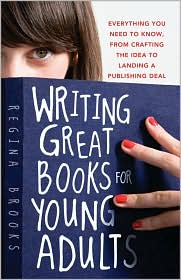
Well, I was going to go to Six Flags today, but it's raining here. I'm pretty disappointed, it was going to be my first time going. But this just leaves me time to reflect and blog on a book I've started reading, Writing Great Books for Young Adults by Regina Brooks.
 As the title says, this is a guide to writing YA and eventually getting it published. I finished Chapter 5 last night. In Chapter 3, "Meeting Your Characters" Brooks suggested something for discovering your protagonist that I found interesting: hold "auditions" for your protagonist, as if it were for a reality show. Find the one that suits your story. I think for the most part, I'll be doing this for secondary characters, because I feel I often have trouble evolving them when I'm not as focused on their thoughts and motives as I am the character(s) who's story I'm telling. It's pretty easy for me to figure out what a character is like when the story is centered around them. However, one of my protagonists is causing me some trouble. I've started writing this one character's story, but she's not quite right yet. Among other problems with the plot, I'm scrapping that one and starting over. And I think I will begin with auditions for my main girl.
Also, in the last chapter I read, "Building Your Plot" Brooks suggests storyboarding, writing out events on index cards an arranging them. I think that I'm going to use this tool as well. In the past I've had ideas in my head but never really wrote them down in any order. In general, I'm not much of a outline on paper person, I just keep it in my head. But I might as well start practicing different methods to improve.
Also, in the last chapter I read, "Building Your Plot" Brooks suggests storyboarding, writing out events on index cards an arranging them. I think that I'm going to use this tool as well. In the past I've had ideas in my head but never really wrote them down in any order. In general, I'm not much of a outline on paper person, I just keep it in my head. But I might as well start practicing different methods to improve.
Subscribe to:
Posts (Atom)