Yesterday was a much shorter day for me due to the inability (or lack of desire) to get up and school assignments.
I started out with the main address, which was given by James Dashner. He talked about his journey through publishing, and I have to say, if you ever get the chance to hear him speak you should, because he is a really funny guy (even though he tries to trick you by naming the title of his presentation "Most Boring Keynote Speech EVER"). He emphasized the importance of networking, which, admittedly, scares me. I'm not so much of a network. I have trouble just going up and talking to people. Another huge point he pressed is that if we worked hard, we'd have success.
Then I went to a panel called "Military on Military SF" with Steve Harrison, Frank Hennis, Brad R. Torgersen, and Tyler Whitesides.
This is mostly for a future reference for me for another idea I have, but won't work on for a while. They talked a lot on the flaws that science fiction has with real military life, and some things SF does right on that aspect.
Then I had to go home, eat lunch, go to the bookstore, and so I missed an hour before I went back for the book signing with James Dashner. I found out that my copy of The Maze Runner was in the 10th printing, which is actually a really low number. He said the only one lower he'd seen was a four. And, I have to put this in, but he asked me if I was a writer. I told him that I was and he said, "Don't give up. You'll get published."
I'm going to get published guys. Who knows when or how successful I'll be, but I will.
I only had time for one more presentation, which was with Elana Johnson on "Pitching to Agents/Editors."
This one is mostly for future reference, again. And since she sent around a sheet to put down our email address where she would email us the presentation, I didn't take very good notes. But again, one of the biggest things for me whas her mentioning to control yourself and not appear nervous. That'll be interesting to see when I do get to the point of pitching.
I'm so sad it's over, it's been an amazing few days!

Showing posts with label LTUE. Show all posts
Showing posts with label LTUE. Show all posts
Sunday, February 20, 2011


Friday, February 18, 2011
Day Two at Life, the Universe and Everything
Since today I was at LTUE from 9am-8pm with the only break to go to one class, this is going to be a heck of a long post. I'll try to keep it interesting with pictures and such.
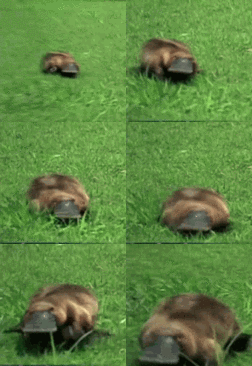
 See? A platypus. Already entertaining.
First Panel: "How to Research, When to Stop, and What to Use" with Dene Low, Scott Parkin, J. Scott Savage, and Eric Swedin.
As this entails, it went over how to research. An idea I have is going to need a whole lot of research, when I get around to it, so this is why I went to this panel (there are abour three or four an hour you can choose to go to). Something that never really crossed my mind that they brought up was talking to people. And after I was like, duh. Of course you can talk to an expert. But I'm a rather shy person and don't think to just go up and talk to people, so this was weird for me. They also talked about different helpful websites (yes, Wikipedia actually can be helpful).
For the 10am hour, I didn't go to a panel. Instead, I went to James Dashner's reading.
Oh, but this was not just any reading. If you don't know, James Dashner wrote The Maze Runner and its sequel, The Scorch Trials. Both of them are fantastic books and if you're into YA and sci-fi dystopia, definitely look into them!
Anyway, the final book of the trilogy, The Death Cure comes out October 11, 2011. But today, I heard Mr. Dashner read the first three chapters and saw the cover, which has not been revealed yet.
 I did take a picture of the cover on my phone, but I'm not posting it because
1. It's from my phone, so it's not exactly the clearest picture in the world.
2. Mr. Dashner will get into trouble if I do.
3. I don't even know how to get a picture on my phone to my computer.
And I can't tell you anything about the first three chapters, except that they are awesome and I am totally pumped for The Death Cure.
The next segment was the main address with Steve Keele. He's an artist that does a lot of fantasy/sci-fi work.
I only got to stay a half hour for the panel of "What Is an Agent, and What Can They Do for You?" with James Dashner, Lesli Muir Lytle, and Tyler Whitesides before I had to go to class.
I wish I could have stayed longer, because it was really helpful in advice about agents. Mr. Dashner shared his experience with an agent that was not the best for him, and how the agent he has now is great for him. Also, it was noted that no agent is perfect, but there are a lot of good ones out there. They also expressed how helpful it was that an agent help edit. Also, it turns out some writers think they don't need an agent, which is very, very wrong.
At this point I had to go to my British Literature class and discuss Thomas Carlyle, and afterwards I hurried back to LTUE. I went into the Storyboard panel at first, which then I realized that they were discussing animation which I have no pressing need to know about, so I switched and went into "The Problems of Sequels" with Larry Correia, Bree Despain, Anna del C Dye, Jessica Day George, and Mette Ivie Harrison.
They hit some key problems authors have with sequels, including backstory of the first book, what to do with a character arc that has already been "completed", and writing a book for the series, not the book itself. They suggested to weave the backstory like you do in the first book of what happened before then. And they also talked about how you shouldn't return a character to the way s/he was at the beginning of the first book--give them new challenges. And, of course, first time authors should write a stand-alone that could become a sequel.
Next came "Plotstorming from Character" with Paul Genesse.
This one talked about how important it is to develop characters with depth and interest, someone the reader can care about. After all, it's characters that really make us want to read on. I know I've read some really interesting plots, but the dull or frustrating characters made me dislike the book. Yet amazing characters I care about have spiced up the plot of an otherwise dull story. My favorite advice: strong characters make choices, so have characters make choices and not just be blown around.
When 4:00 came rolling along, I went to "Rewriting to Greatness: Five Editing Techniques to Help Improve Your Stories" with David Farland.
Basically: Edit a lot. Look at big stuff, little stuff. Don't over-edit, that just kills the story. But objectively look at what works and what doesn't for the story. Flesh out characters more, shorten unneeded descriptions, all of that stuff.
The next panel I attended was "What You Can and Can't Do in a YA Novel" with Mette Ivie Harrison, Elana Johnson, Bree Despain, Robison Wells, and J. Scott Savage.
First, about this, I must say: Get your mind out of it.

Except for one question at the end, no one talked about sex in YA. Instead, they talked about how YA was different from adult books, and in more than just cleanliness and the age of the protagonist (although that is certainly part of it). YA has a tendancy for there to be hope at the end. I mean, really, can you think of a YA book that didn't end with some glimmer of hope or happiness? I haven't read many adult books (I drawing a blank on even one except for classics) but right now they tend to be a lot bleaker.
At 6:00 I attended the panel of "How to Get and Develop Killer Story Ideas" with John Brown and Larry Correia.
They talked about listening to your "zing" sensor, that feeling of what type of situation could make an interesting story. They talked about throwing out ideas for character, plot, setting, and problem. They even encouraged throwing out generic answers and then using them to find a twist to make it original. Then we spent time brainstorming about Wyoming, ghosts, and lost Japanese tourists.
By 7:00, I'm pretty tired and pretty hungry. But, I stuck through for one more hour because the next presentation talked about this:
 "Lessons on Story from The Hunger Games" with John Brown.
The only thing that could make me fangirl more would be if they had "Lessons on Character from Peeta Mellark" with Suzanne Collins.
I think an important point Mr. Brown made was that every story has been done already. I've known Hunger Games getting crap about being "done before" but I agree with Mr. Brown. The Hunger Games is different, and it is awesome.
He also talked about how to capture a reader, there needs to be this equation: Likeability+Problem=Rooting. He also compared Katniss and Rue. We feel sympathy for both, but in the end root for Katniss because she's active and clearly has a good chance at surviving. He talked about dilemma, to not cut your story to proportions but do what is right for it, and to present turns.
The only thing that ruined it was that in one of the pictures on the slideshow, Peeta was being represented by Alex Pettyfer, when obviously this guy is Peeta:
 Hmmm. Hunter Parrish.
Great day, tiring day (although maybe that accounts from my lack of sleep this week...)
Anyway, more tomorrow!
First Panel: "How to Research, When to Stop, and What to Use" with Dene Low, Scott Parkin, J. Scott Savage, and Eric Swedin.
As this entails, it went over how to research. An idea I have is going to need a whole lot of research, when I get around to it, so this is why I went to this panel (there are abour three or four an hour you can choose to go to). Something that never really crossed my mind that they brought up was talking to people. And after I was like, duh. Of course you can talk to an expert. But I'm a rather shy person and don't think to just go up and talk to people, so this was weird for me. They also talked about different helpful websites (yes, Wikipedia actually can be helpful).
For the 10am hour, I didn't go to a panel. Instead, I went to James Dashner's reading.
Oh, but this was not just any reading. If you don't know, James Dashner wrote The Maze Runner and its sequel, The Scorch Trials. Both of them are fantastic books and if you're into YA and sci-fi dystopia, definitely look into them!
Anyway, the final book of the trilogy, The Death Cure comes out October 11, 2011. But today, I heard Mr. Dashner read the first three chapters and saw the cover, which has not been revealed yet.

1. It's from my phone, so it's not exactly the clearest picture in the world.
2. Mr. Dashner will get into trouble if I do.
3. I don't even know how to get a picture on my phone to my computer.
And I can't tell you anything about the first three chapters, except that they are awesome and I am totally pumped for The Death Cure.
The next segment was the main address with Steve Keele. He's an artist that does a lot of fantasy/sci-fi work.
I only got to stay a half hour for the panel of "What Is an Agent, and What Can They Do for You?" with James Dashner, Lesli Muir Lytle, and Tyler Whitesides before I had to go to class.
I wish I could have stayed longer, because it was really helpful in advice about agents. Mr. Dashner shared his experience with an agent that was not the best for him, and how the agent he has now is great for him. Also, it was noted that no agent is perfect, but there are a lot of good ones out there. They also expressed how helpful it was that an agent help edit. Also, it turns out some writers think they don't need an agent, which is very, very wrong.
At this point I had to go to my British Literature class and discuss Thomas Carlyle, and afterwards I hurried back to LTUE. I went into the Storyboard panel at first, which then I realized that they were discussing animation which I have no pressing need to know about, so I switched and went into "The Problems of Sequels" with Larry Correia, Bree Despain, Anna del C Dye, Jessica Day George, and Mette Ivie Harrison.
They hit some key problems authors have with sequels, including backstory of the first book, what to do with a character arc that has already been "completed", and writing a book for the series, not the book itself. They suggested to weave the backstory like you do in the first book of what happened before then. And they also talked about how you shouldn't return a character to the way s/he was at the beginning of the first book--give them new challenges. And, of course, first time authors should write a stand-alone that could become a sequel.
Next came "Plotstorming from Character" with Paul Genesse.
This one talked about how important it is to develop characters with depth and interest, someone the reader can care about. After all, it's characters that really make us want to read on. I know I've read some really interesting plots, but the dull or frustrating characters made me dislike the book. Yet amazing characters I care about have spiced up the plot of an otherwise dull story. My favorite advice: strong characters make choices, so have characters make choices and not just be blown around.
When 4:00 came rolling along, I went to "Rewriting to Greatness: Five Editing Techniques to Help Improve Your Stories" with David Farland.
Basically: Edit a lot. Look at big stuff, little stuff. Don't over-edit, that just kills the story. But objectively look at what works and what doesn't for the story. Flesh out characters more, shorten unneeded descriptions, all of that stuff.
The next panel I attended was "What You Can and Can't Do in a YA Novel" with Mette Ivie Harrison, Elana Johnson, Bree Despain, Robison Wells, and J. Scott Savage.
First, about this, I must say: Get your mind out of it.

Except for one question at the end, no one talked about sex in YA. Instead, they talked about how YA was different from adult books, and in more than just cleanliness and the age of the protagonist (although that is certainly part of it). YA has a tendancy for there to be hope at the end. I mean, really, can you think of a YA book that didn't end with some glimmer of hope or happiness? I haven't read many adult books (I drawing a blank on even one except for classics) but right now they tend to be a lot bleaker.
At 6:00 I attended the panel of "How to Get and Develop Killer Story Ideas" with John Brown and Larry Correia.
They talked about listening to your "zing" sensor, that feeling of what type of situation could make an interesting story. They talked about throwing out ideas for character, plot, setting, and problem. They even encouraged throwing out generic answers and then using them to find a twist to make it original. Then we spent time brainstorming about Wyoming, ghosts, and lost Japanese tourists.
By 7:00, I'm pretty tired and pretty hungry. But, I stuck through for one more hour because the next presentation talked about this:

The only thing that could make me fangirl more would be if they had "Lessons on Character from Peeta Mellark" with Suzanne Collins.
I think an important point Mr. Brown made was that every story has been done already. I've known Hunger Games getting crap about being "done before" but I agree with Mr. Brown. The Hunger Games is different, and it is awesome.
He also talked about how to capture a reader, there needs to be this equation: Likeability+Problem=Rooting. He also compared Katniss and Rue. We feel sympathy for both, but in the end root for Katniss because she's active and clearly has a good chance at surviving. He talked about dilemma, to not cut your story to proportions but do what is right for it, and to present turns.
The only thing that ruined it was that in one of the pictures on the slideshow, Peeta was being represented by Alex Pettyfer, when obviously this guy is Peeta:

Great day, tiring day (although maybe that accounts from my lack of sleep this week...)
Anyway, more tomorrow!
Thursday, February 17, 2011
The (Short) Adventure at Life, the Universe, and Everything
Last night I discovered at the meeting with Stacy Whitman that my school was holding a type of writers convention targeted toward fantasy and science fiction writers called Life, the Universe, and Everything. And I found out it was happening today, tomorrow, and Saturday. Naturally, I wanted to go. So I registered late last night.
Sad thing, though, is that I work from 6-11am and have class from 1:35-6:30 on Thursdays, so today I could only go for one hour. I got off work a bit past 11, rushed home, showered, then realized I hadn't printed my registration, and since I don't have a printer and my roommates weren't home for me to use one of theirs, I had to rush down to the central building for the dorms to print it out, then speed-walk it to the one session I was able to go to, which was Killer Openings: the first paragraph will make or break your story with Stacy Whitman, Lisa Mangum, Dene Low, Jessica Day George.
To top it off, when I got there, I realized I'd forgotten my notebook, so I had to take notes on my phone. Hopefully no one thought I was just texting. Being on the younger side of the audience, we do have a stereotype for doing such things.
Some of the notes that I took on writing that beginning few pages include:
Sad thing, though, is that I work from 6-11am and have class from 1:35-6:30 on Thursdays, so today I could only go for one hour. I got off work a bit past 11, rushed home, showered, then realized I hadn't printed my registration, and since I don't have a printer and my roommates weren't home for me to use one of theirs, I had to rush down to the central building for the dorms to print it out, then speed-walk it to the one session I was able to go to, which was Killer Openings: the first paragraph will make or break your story with Stacy Whitman, Lisa Mangum, Dene Low, Jessica Day George.
To top it off, when I got there, I realized I'd forgotten my notebook, so I had to take notes on my phone. Hopefully no one thought I was just texting. Being on the younger side of the audience, we do have a stereotype for doing such things.
Some of the notes that I took on writing that beginning few pages include:
- Show your voice.
- Get the reader to care about something, usually a character or a problem.
- Avoid telling too much backstory in the first chapter.
- Avoid a prologue unless someone in the prologue is alive. Make a prologue for a good reason, not just to be, as Ms. George said, "fancy." Also, make sure it's not just a first chapter with a prologue as the title.
- Know your audience to grab them in, and don't be too different (like writing a YA with so much gruesome torture your beta readers think it's a horror).
- It's ok to start with a dialogue, or even an "ordinary" day of the character, as long as it's interesting. It creates stability and an introduction to the character's life.
- Avoid the narrator being condescending to the reader.
- Write for you reader, not an editor. The editor is the reader anyway.
- Only start with what is relevant, there is no need to go into tons of detail that serve no purpose.
- Try to write as if the reader is already in the world--basically, cut down on the explaining of what clothes or houses or transportation, etc. look like.
Subscribe to:
Posts (Atom)